BIGSTORY Network


The Challengers Aug. 16, 2026, 5:01 p.m.

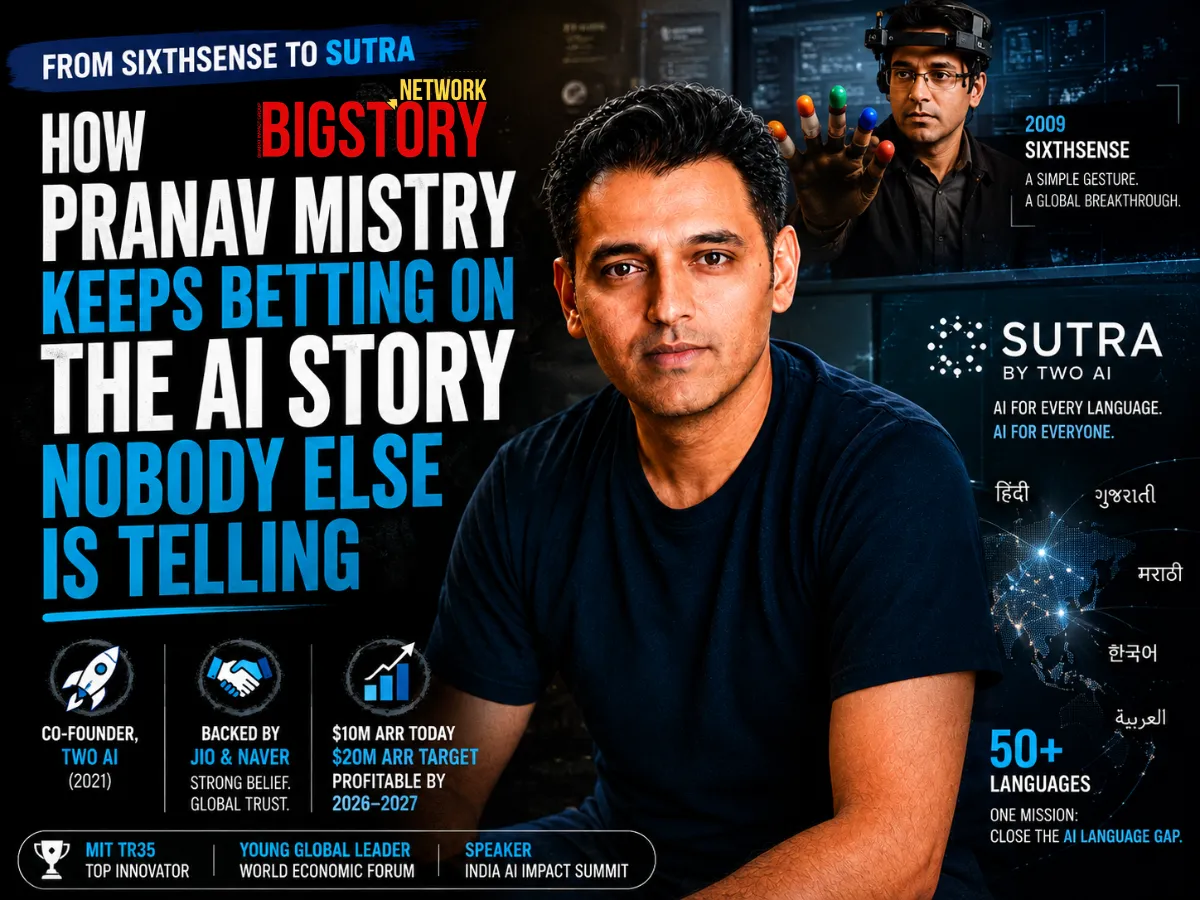
From SixthSense to SUTRA: How Pranav Mistry Keeps Betting on the AI Story Nobody Else Is Telling

Explore how Pranav Mistry is shaping the future of human-centered AI with TWO AI and the SUTRA series. From SixthSense to domain-specific, multilingual AI, discover how India is innovating beyond scale for true global accessibility.
by Author Rashmeet Kaur Chawla
Hero Image

The Language Gap: How Pranav Mistry is Rewiring AI for the Rest of the World

Expand to Read

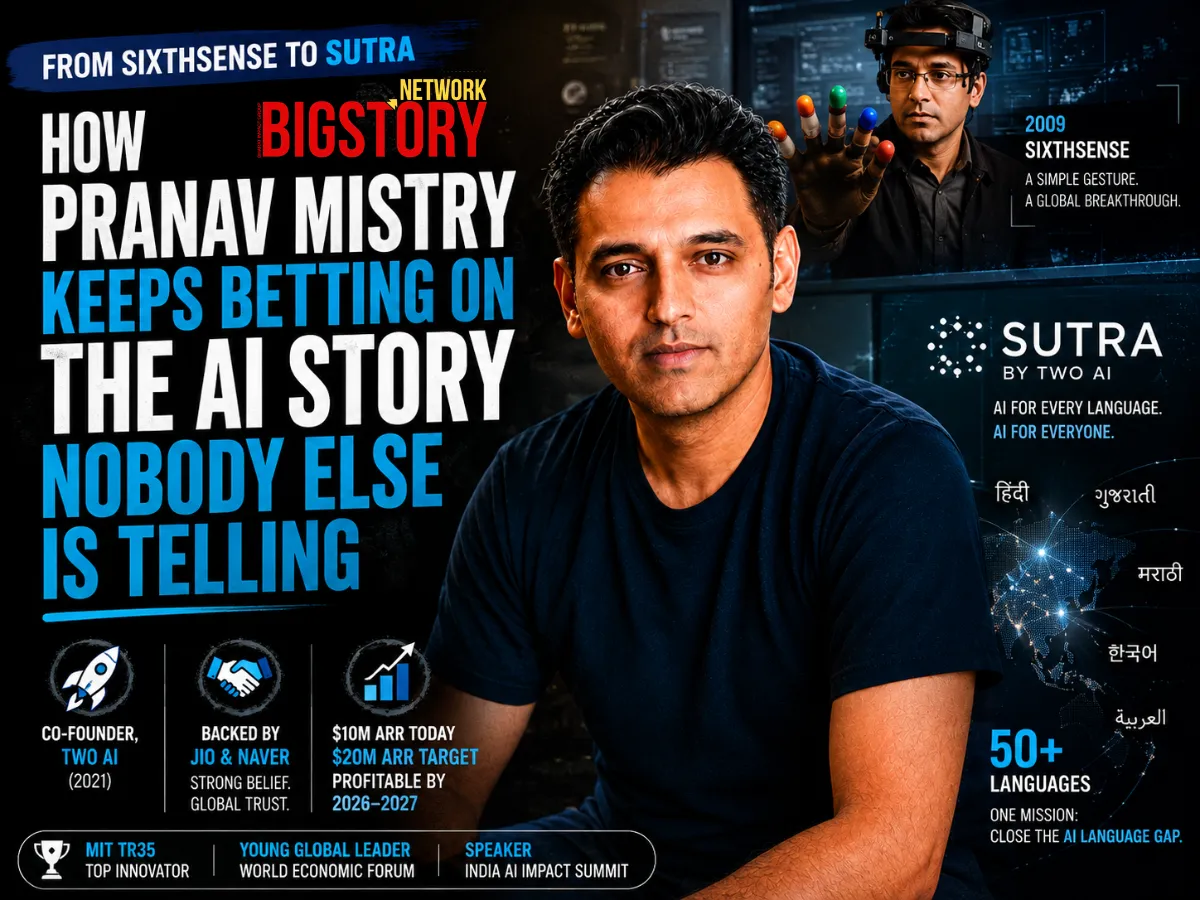
  • The Problem: Silicon Valley’s obsession with massive, general-purpose AI models has created a deep language gap. By training predominantly in English, the tech industry treats hundreds of millions of non-English speakers as an afterthought.
  • The Turning Point: Pranav Mistry—the visionary who broke into global tech with his 2009 "SixthSense" demo and later led Samsung's STAR Labs—co-founded TWO AI in 2021 to fundamentally challenge how AI is built.
  • The Strategy: Instead of trying to out-spend mega-corporations on massive language models, Mistry pivoted to building smaller, highly specialized models (the SUTRA family). His core focus is on regional languages (Gujarati, Marathi, Korean, Arabic) and "world models" that process real-world data like finance and farming.
  • The Result: Backed by giants like Reliance Jio and South Korea's Naver, TWO AI has secured over 10 major enterprise clients, hitting around $10 million in Annual Recurring Revenue (ARR) with a clear path to profitability by 2026–2027.

In 2009, a simple hand gesture made the tech world take notice. Sixteen years later, Pranav Mistry is betting his company on non-English languages a space much of Silicon Valley still treats as a low priority.

Imagine a stage in California in 2009. A man wearing a basic setup made of a webcam, a small projector, and colored caps on his fingers turns his palm into a keyboard, a photo into a physical picture frame, and a newspaper page into a playing video. It wasn't a polished corporate presentation, nor did it have a billion-dollar budget.

It was built on one clear idea: technology should adapt to humans, not force humans to adapt to technology.

That man is Pranav Mistry. His demo, called SixthSense, made him the first Indian technologist to enter the top ranks of global consumer technology.

Sixteen years later, Mistry is demonstrating something completely different. Instead of hand-gesture tools, he is building AI models that speak Gujarati, Marathi, Korean, and Arabic as naturally as English. Instead of trying to build the largest models like major Silicon Valley labs do, he regularly argues that sheer size is no longer what matters. Throughout his career, his guiding philosophy has remained consistent across every project.

A Career Built on Bridging Worlds

Long before "human-centered AI" became a common phrase in pitch decks, Mistry was already working on the concept. Born in Palanpur, Gujarat, he went from local studies to the MIT Media Lab in Silicon Valley.

There, he created SixthSense - a wearable system that let people interact with digital data in physical space before smartwatches or AR glasses existed.

That same drive to connect digital logic with human intuition led him to Samsung. Over nearly a decade, he rose to Global Vice President of Research and founded STAR Labs (Samsung Technology & Advanced Research Labs). He led NEON, an ambitious project to create artificial "virtual humans" capable of realistic conversations years before AI avatars became popular.

In 2021, Mistry co-founded TWO AI in Silicon Valley on a clear premise: the future of AI will not belong to whoever builds the largest model, but to whoever builds the most useful one.

Betting on Language, Not Just Model Size

TWO AI’s main project, the SUTRA model family, was built to fill a major gap. Most large language models were trained mostly in English. This left hundreds of millions of Hindi, Gujarati, Bengali, Marathi, Punjabi and Korean speakers treated as an afterthought.

Mistry’s goal has been clear: close the AI language gap by making technology accessible and affordable in the languages people actually speak every day.

SUTRA now supports over 50 languages. TWO AI states that it performs better than several major general-purpose models on multilingual tests in languages where quality data is hard to find.

Mistry’s strategy has continued to evolve:

  • From Big Models to Specialization: By 2025, as massive general-purpose models from big tech companies became common, he shifted TWO AI away from making large general models. Instead, the company focused on smaller, specialized models trained for specific fields like healthcare diagnostics and retail forecasting. The core logic: a small model that does one task exceptionally well is better than a huge model that does many tasks average-well.
  • Beyond Text-Based Chatbots: More recently, Mistry argued that India’s AI progress shouldn't be judged by how fast it catches up to Western language models. Instead, the next big step will come from quantitative and world models systems built to process real-world data like finance, weather, traffic, farming conditions, and camera feeds.

Backing That Speaks for Itself

TWO AI’s investors reflect strong support for Mistry’s focus on regional languages. The company has raised funding from Reliance Jio and South Korea's Naver Corporation. Jio’s investment gives TWO AI access to hundreds of millions of Indian households, providing a broad distribution network that few AI startups can match.

The financial metrics show steady progress:

  • TWO AI reports an Annual Recurring Revenue (ARR) of around $10 million.
  • The company aims to reach $20 million in ARR and become profitable by 2026–2027.
  • It has over 10 enterprise clients generating around $1 million each per year, along with customers across Korea, Southeast Asia, the Middle East, and government AI projects in India.
  • Beyond his company, Mistry was named to MIT Technology Review’s list of top innovators under 35 (TR35) and selected as a Young Global Leader by the World Economic Forum. He also continues to speak at major industry events like the India AI Impact Summit.

The Parts of the Story Most Profiles Skip

While most public profiles focus only on SixthSense and Samsung, Mistry’s journey includes several other notable milestones:

  • Work Before MIT: Before joining MIT, Mistry worked as a User Experience (UX) researcher at Microsoft. He has also worked with Google, Carnegie Mellon University, NASA, UNESCO, and Japan’s Science and Technology Agency.
  • Other Inventions: Beyond SixthSense, his inventions include:
  • Mouseless: An invisible computer mouse that tracks hand movements without hardware.
  • Sparsh: A gesture system to copy and paste data between different devices.
  • Quickies: Intelligent sticky notes that can send digital reminders.
  • Blinkbot: A robot controlled by eye movement and blinking.
  • Early Recognition: In 2009, Mistry was nominated for Forbes India’s Person of the Year based on the SixthSense demo alone a rare recognition for an early prototype.
  • Co-founders and History: Mistry co-founded TWO AI alongside Abhijit Bendale. The company started in 2018 focused on artificial reality and immersive experiences before shifting its core focus to the SUTRA language models.

Challenges and Market Reality

By independent market rankings, TWO AI ranks 35th out of 135 active competitors in its sector. Compared to major industry leaders like OpenAI, which have raised tens of billions of dollars, TWO AI’s $20 million in funding is quite small. Its focus on regional languages and small specialized models is still being tested against large-scale competitors.

Competing with limited capital against heavily funded rivals requires strong conviction, and the long-term result will depend on the company's ability to secure enterprise contracts and reach profitability.

Facing the Giant: His Real-World Challenges

Mistry's path has not been without significant friction and hurdle points:

  1. The Scale & Funding Gap: Running a lean startup like TWO AI with ~$20M in funding against mega-corporations with $100B+ budgets means he cannot out-spend competitors. He must out-think them.
  2. Translating Prototypes into Mass Products: While SixthSense took the world by storm in 2009, turning an open-source research prototype into a polished, mass-manufactured consumer hardware product proved complex due to proprietary component software and manufacturing hurdles.
  3. Pioneering Ahead of the Market: Inventions like invisible mice (Mouseless), gesture copy-pasting (Sparsh), and virtual humans (NEON) were often years ahead of consumer readiness, requiring him to repeatedly educate market sectors before demand existed

What Makes His Work Truly Unique?

Most Silicon Valley pioneers build software that locks users behind screens and keyboards. Mistry’s signature style is completely opposite:

  • Pop Pixels into the Real World: Instead of putting humans inside digital screens, he brings digital information out into physical, everyday reality.
  • Resource Constraints as a Creative Superpower: Mistry often emphasizes that lacking a massive budget pushes you to be more creative. SixthSense was built using off-the-shelf components that existed decades ago, but combined in a way nobody had imagined.
  • Mythology over Sci-Fi: Rather than deriving inspiration from Western science fiction, Mistry has frequently credited Indian folklore and real-life everyday problems as the roots for his inventions.
  • Focus on Inclusion & Accessibility: He builds for people left behind by traditional tech—from tools designed for the visually and hearing impaired, to non-English speakers navigating complex digital systems.

The Main Takeaway: Building for the Excluded

Mistry’s perspective offers a different way to view tech leadership:

  • Progress doesn't always mean trying to copy or race against the market leader.
  • Valuable opportunities come from asking: Who is being left out by this technology, and how can we build for them first?
  • Regional languages are essential infrastructure rather than extra features.
  • Real credibility comes from consistent work over many years rather than a single popular demonstration.

The Challenger's Manifesto

Core Principles derived from Pranav Mistry’s Journey & Philosophy

True innovation isn't about running faster in a race set by market leaders. Progress happens when you step off the track and target the opportunities incumbents ignore.

Humans shouldn't have to learn the language of machines. Computing must adapt naturally to human intuition, regional dialects, and physical habits.

Innovation shouldn't serve only the top demographic. The most urgent value lies in building for the languages, regions, and communities left behind as "edge cases."

Non-English languages are not secondary add-ons to patch in later they are the foundational baseline for democratizing global technology.

True credibility is not built on valuation multiples or viral press cycles, but on sustained, practical impact across economic cycles.

From the Editor's Desk

Most stories written about artificial intelligence focus on scale the biggest training clusters, the largest capital raises, or the loudest product launches. Rarely do they pause to ask who is being served by those models, or who is systematically left out.That narrative often overlooks the hundreds of millions of people who do not speak, search, or work in English.

Pranav Mistry’s career has focused on this gap: from wearable interfaces in 2009, to virtual humans at Samsung, to building AI models for languages like Gujarati and Marathi today.

While TWO AI is not the largest company in the industry, its central thesis — that AI should prioritize practical usefulness over pure model size remains a relevant and important perspective for the future of technology.

Sources

  • https://www.forbesindia.com/article/ai-special-2025/pranav-mistry-its-time-to-build-valuedriven-ai-models-to-transform-industries-daily-lifes/96195/1
  • https://www.forbesindia.com/article/take-one-big-story-of-the-day/will-india-have-its-own-ai-model/95392/1
  • https://arxiv.org/abs/2405.06694
  • https://www.chartwellspeakers.com/speaker/pranav-mistry/
  • https://motivationalspeakersagency.co.uk/technology-speakers/pranav-mistry
  • https://www.indiatimes.com/technology/news/pranav-mistry-has-built-worlds-1st-artificial-human-that-looks-and-behaves-just-like-us-503716.html
  • https://www.ted.com/speakers/pranav_mistry
Rashmeet Kaur Chawla
Rashmeet Kaur Chawla Senior Editor
Rashmeet is a creative content writer driven by a passion for meaningful storytelling. She crafts clear, engaging narratives that leave a lasting impact. As an Editor at BIGSTORY NETWORK, she’s committed to sharing stories that inspire change, spark conversations, and connect diverse communities, using the power of words to promote understanding and foster a more inclusive world.

BIGSTORY Trending News! Trending Now! in last 24hrs

The Physicist Who Said No to AIR 1's Only "Right" Answer
The Challengers
The Physicist Who Said No to AIR 1's Only "Right" Answer
From SixthSense to SUTRA: How Pranav Mistry Keeps Betting on the AI Story Nobody Else Is Telling
The Challengers
From SixthSense to SUTRA: How Pranav Mistry Keeps Betting on the AI Story Nobody Else Is Telling
Dr. Kiran Modi: Turning Grief Into a Lifelong Fight for Children Without Parental Care
The Challengers
Dr. Kiran Modi: Turning Grief Into a Lifelong Fight for Children Without Parental Care
Sanjana Tiwari Redefined Success in Mandi House with The Wooden Stool Empire
The Challengers
Sanjana Tiwari Redefined Success in Mandi House with The Wooden Stool Empire